Reflections on governance

Wednesday, 25 February 2026 | Issue 0016 | Pocono Pines
The giving of the light
I didn’t mean for it to happen. But I, like a considerable cohort among us, spent one hour and 48 minutes watching US President Donald Trump’s State of the Union address last night. I tried to rally and watch the Democratic response. But it was futile. I knew I wouldn’t be moved. Like the speech before it, anything else I listened to would be a sophomoric style of politics — sound and fury, signifying nothing.
Here’s why:
In the same way Toni Morrison was once bored with evil, I’ve grown weary with the singularity of self-interest. It lacks depth. It’s too easy. It has no sense of the sublime.
Relatedly, I’m tired of how we think about and practise power. It’s reductive. And bland. There’s a scarcity of spirit.
Last night’s speech exemplified the evil of which Toni Morrison spoke. It had a costume. (Witness the public pain of people afflicted by violence and greed.) It did a double-take. (Heard in the clangorous claims that “America is back!”) It hollered. (Noted in the repeated refrain that some congresspeople are “sick” and “crazy.”) All because, as she said, “it is nothing.”
Goodness has none of the trappings of its counterpart. It is humble in its appearance. It has a quiet, consciousness-raising voice. And yet, it is what I, like Morrison, find most compelling. More importantly, it is what is necessary.
James Baldwin once said, “An old world is dying, and a new one, kicking in the belly of its mother, time, announces that it is ready to be born. This birth will not be easy, and many of us are doomed to discover that we are exceedingly clumsy midwives. No matter, so long as we accept that our responsibility is to the newborn: the acceptance of responsibility contains the key.” As human beings, we are in a time of turbulent transition. The collective nature of our life is akin to the stages we go through in human development. We are born as infants. We grow to be children. We experience adolescence. And we come of age in our maturity. While our maturity as humanity, like that of a growing child, is inevitable — “it is in the makeup of a child to become an adult” (Farid-Arbab, 2018) — when we reach this milestone and how we do it are less clear. Neither will happen without our concerted efforts. Just as the development of a child will be stunted without the wisdom, guidance, care, and love of adults, our destiny could linger through a prolonged and fitful transition. Yet, as Baldwin encourages, our task isn't to force maturity into being, but to tend faithfully to the conditions that make it possible. We are responsible to the means that will bring about this end.
This, however, is not the way our world is ordered. The evils of which Toni Morrison and James Baldwin speak are the dominant form of human perception and expression. We witness them in the triplets of racism, materialism, and militarism elaborated by Martin Luther King Jr. They are powerful, yet fraudulent forces. Like all evil, they are bereft. What’s more, they are lies.
Racism, materialism, and militarism are fabrications manufactured to divorce us from the depth of our interior lives and the richness of our common humanity. They erect walls of human (in)difference, hoard resources without end, and pull the planet into plunder. The vastness of their destruction is well documented. Yet they are as common to us as breathing air.
Ordinary though they may be, I saw their consequence registered in the subtlety of the facial expressions of several people who crossed my screen during the State of the Union. They exhibited a private, yet perceptible grief. In the spotlight of the moment, you could start to shape the contours of what it cost: A denial of truth. A divorce from reality. A deadening of the soul.
When the price of the ticket is this high, why do we keep paying for this lie?
Experimental and exploratory to be sure, the alternative is, as Morrison conceived, much more interesting. It’s a challenge. It is us putting down the belief in the superiority of one group over another. In doing so, we begin to see each other, not as strangers or competitors, but as members of a widespread, united human family whose fates are intertwined. We learn what it means to go this hard way with each other. And unlike the evils before it, this is what will endure.
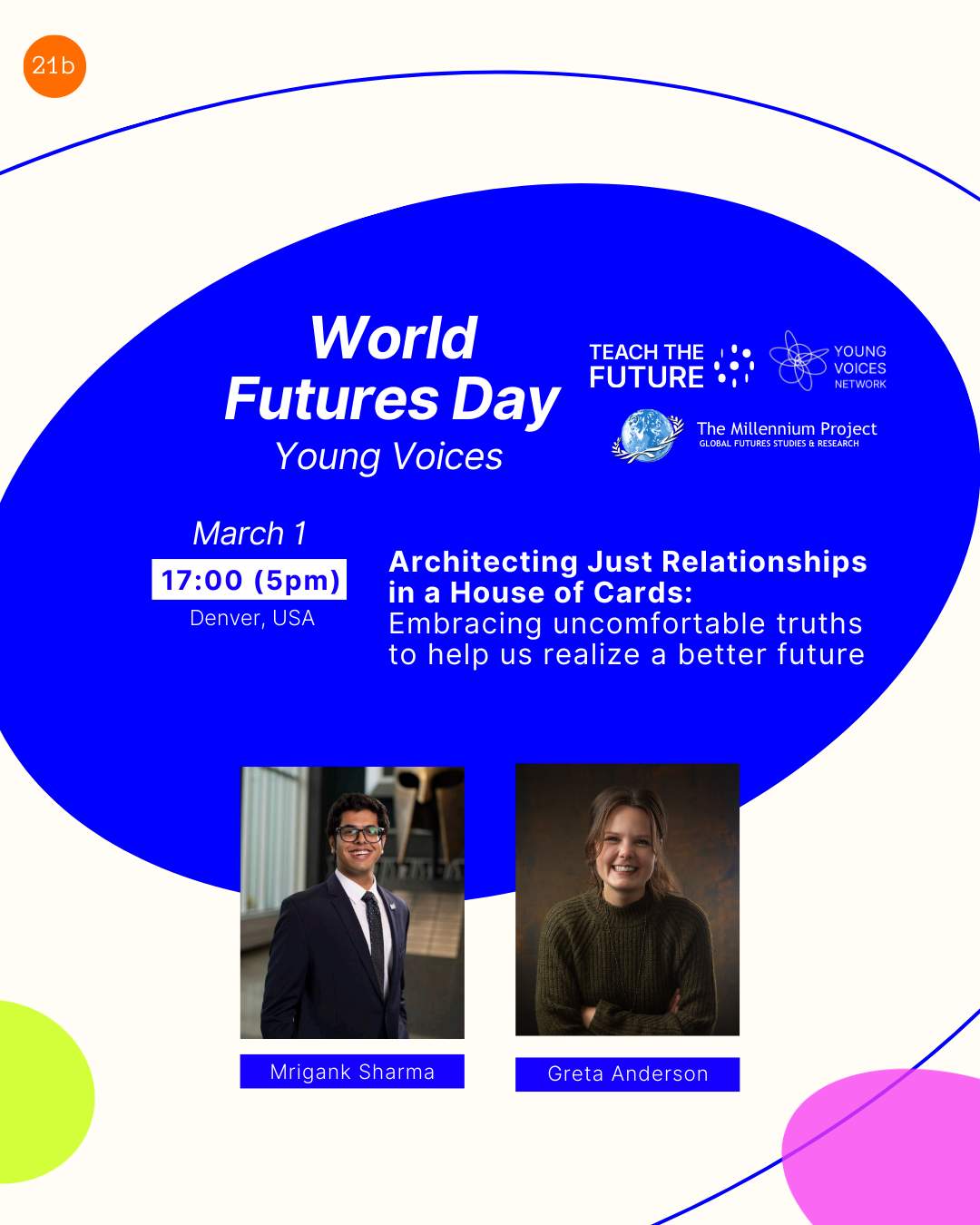
Two volunteers — an international student majoring in environmental studies and a design strategist devoted to the emergence of innovative and kind products — are engaged in this very effort. On World Futures Day, they will host a conversation with educators and youth. And we expect, in that room, unlike the chambers of our Capitol, that the breezes of confirmation will waft upon and refresh participants equally weary of evil. And in that moment, a nourishingly new and truthful way of speaking together so that we can take action to better live together in this world will be made manifest.
What makes this possible is a humble posture of learning. Committed to the apprehension of knowledge, facilitators and participants alike will recognise the limitations of their own understanding. This humility provides a liminal space, generous and generative, in which we can individually and collectively craft stronger thoughts of peace and more powerful thoughts of love.
Like the midwife Baldwin described, we may find ourselves clumsily clinging to our more potent thoughts of peace and love. That’s what we must commit ourselves to doing. Yet that is not all we must do. As the scientist and cultural convener David Edwards has made clear, “it is when we create value for others over a long time that we evoke the idea of the sublime.” The timeline toward our maturity is long. The treasure in possessing and nurturing peace, love, and learning that redefine power, then, is in sharing them with the world and making their imprint indelible on us as individuals, on our communities, and on our institutions.
In a world like this — the world that is fitfully being born, the one we’re clumsily receiving — we not only become conscious of the oneness of humanity, but we strive to embody that reality through our thoughts, actions, and being every day.
If you read this newsletter to its end, we want to be your companion in creating a coherent life. If you join the World Futures Day conversation, we want to accompany you in applying your learnings through social action. If you’re a longstanding member of our email list, we want to continue learning alongside you. What we have to offer is less a programme, and more our presence. You can turn to us, as we hope we can turn to you, for dialogue, deliberation, and deepening.
We bear witness to the giving of the light. The dawn of a new day is breaking. The new world being born is crowning. Welcome to the age of alignment.
See you next Wednesday.
— The editors