Reflections on governance
Wednesday, 31 December 2025 | Issue 0014 | Pocono Pines
Good afternoon, from a less windy day in the Pocono Mountains.
As 2025 comes to a close, I'm taking stock of our lessons learned and our accomplishments. One of the things we achieved earlier this year was starting a weekly newsletter. We published it as a resource for the members of our advisory board. The newsletter offered reflections on the concepts and practices of governance found in this piece by the Institute for Studies in Global Prosperity.
Today, we're bringing that newsletter back. And we're sharing it with you!
In this issue, we reflect on what it means to develop capacities for effective governance in today's world. We offer insights and analysis from PBS Newshour and Democracy Now! that provide cautionary and constructive examples of community, dialogue, service, literacy, and the media.
The power of mutual aid. Profound and moving things are possible when we connect with our neighbors and engage in acts of service.
The role of reading. Human superintelligence, not a technological one, relies on a regular rhythm and practice of reading.
A beautiful question. What hath we wrought, and how will we use our inventions?
We can reshape our relationships and communities through mutual aid
On Christmas Eve, PBS Newshour shared a story about the community of Richmond, New Hampshire. Tom Tague, a resident who often provided help to others, now finds himself in need of help. As winter sets in and temperatures dip, Tom is in need of a regular supply of firewood. Because of his pacemaker, Mr. Tague can no longer chop the wood himself. So, volunteers from the Church of Jesus Christ of Latter Day Saints, of which Mr. Tague is a member, connected him with 20-year-old Peter Brown. Before being connected to Mr. Tague, Peter struggled with loneliness. He would wave to people in class, but he didn’t have any real friends. Now, he chops the firewood for Mr. Tague. And what he gets is so much more: a feeling of belonging and a sense of mutual support. It's a small act of kindness and generosity that has the power to warm homes and hearts.

Peter and Tom's story reminds us that governance starts with people. It depends on the values and capabilities we cultivate as individuals, and on the relationships we build with each other and our institutions.
Watch the PBS Newshour story. Check out more of Judy Woodruff's pieces from her "America at a Crossroads" series. And consider how you might serve your community in ways that nurture genuine unity.
Although in limited supply, literacy and dialogue are the keys to human superintelligence
The previous PBS Newshour story ends with a feature of Carol Buffum, a Brattleboro, Vermont resident. Inspired by the women's group she joined at her local church, she's eager to start a dialogue group of her own in her apartment building.
Dialogue is at the heart of a recent PBS Newshour interview with the author David Baldacci and his wife. They've partnered with Virginia Commonwealth University, where Baldacci received both a bachelor's degree and his law degree, to host a series of constructive, yet purposefully not conflict-free conversations about the issues, problems, and opportunities facing our communities today. The hope is that these conversations will be fact-based, educational, and fun experiences for all who participate.

Later in the interview, Baldacci speaks about the importance of longform reading in today's world. He knows people are doing little of it, youth in particular. Yet he doesn't lean into the nostalgia of a bygone era. Instead, he makes a salient connection: Perhaps the leaders of today's technology companies are on to something. The key to superintelligence, they believe, is having AI read all the books ever published. Maybe the progress of humankind lies not just in reclaiming longform reading, but in learning to speak to and engage with each other in more constructive ways.
It's hard to contribute to the kind of dialogue the Baldaccis are describing if you're getting your news from the fragments and falsehoods on social media. Governance requires the capacity "to grasp the core of the important problems and complex needs of the time." For young people especially, reclaiming longform reading isn't nostalgia. It's an awakening. It's what will help them, and all of us, arise and exert our energies in ways that lead to our abiding honor. So here's a question for 2026: What if you committed to reading one longform piece each week and discussing it with someone who might see the world differently than you do?
Watch the PBS Newshour conversation for more insights from David Baldacci and his wife. Read about their Civil Discourse and Collaboration Initiative.
Our future depends on how well we can manage the miracles we've brought into being
As part of their holiday lineup, Democracy Now! reflected on their 2011 interview with the journalist and public figure, Bill Moyers. In the interview, Moyers raises concerns that seem more prescient today than perhaps they were 14 years ago when the interview first aired. An iconic quote — his opening line, in fact — is featured in the image below:
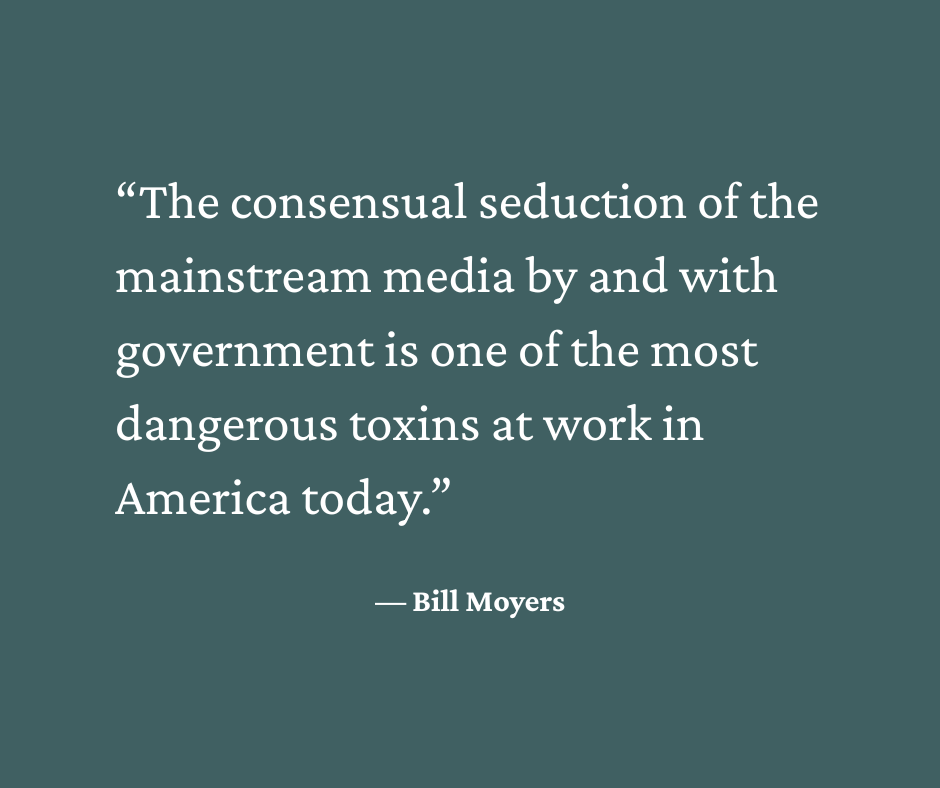
As an antidote to this toxin and the snuffing out of the public good, Moyers offers the "independent analysis and reporting" of public broadcast as well as media outlets like Democracy Now! This is where, "the highest expression of the creative and journalist arts" can be found and readily accessed.
In his conversation with the Democracy Now! team, Moyers calls upon us to revisit Lyndon Johnson's speech before signing the Public Broadcasting Act of 1967. In that speech, Johnson shares the following story:
It was in 1844 that Congress authorized $30,000 for the first telegraph line between Washington and Baltimore. Soon afterward, Samuel Morse sent a stream of dots and dashes over that line to a friend who was waiting. His message was brief and prophetic and it read: "What hath God wrought?"
Every one of us should feel the same awe and wonderment here today.
For today, miracles in communication are our daily routine. Every minute, billions of telegraph messages chatter around the world. Some are intercepted on ships. They interrupt law enforcement conferences and discussions of morality. Billions of signals rush over the ocean floor and fly above the clouds. Radio and television fill the air with sound. Satellites hurl messages thousands of miles in a matter of seconds.
Today our problem is not making miracles — but managing miracles. We might well ponder a different question: What hath man wrought — and how will man use his inventions?
The law that I will sign shortly offers one answer to that question.
It announces to the world that our Nation wants more than just material wealth; our Nation wants more than a "chicken in every pot." We in America have an appetite for excellence, too.
While we work every day to produce new goods and to create new wealth, we want most of all to enrich man's spirit. That is the purpose of this act.
For young people coming of age in an era of social media algorithms, AI-generated content, and platform monopolies, LBJ's question is more urgent than ever: How will we use our communications miracles? Will we manage them for the enrichment of the human spirit and the public good, or will we let them manage us, fracturing our attention and eroding our capacity for the kind of sustained engagement that governance requires? The answer depends on the choices we make — about where we get our information, how critically we evaluate it, and whether we support media that serves the public interest rather than private profit.
Watch the Democracy Now! interview with Bill Moyers and read LBJ's speech before signing the Public Broadcasting Act of 1967.
With that last story fresh on your mind, here's a commitment worth considering: What if you pledged to support at least one independent news source in 2026, whether through a subscription, a donation, or simply by sharing their work with others who need to hear it?
Join us as a paid subscriber to "Reflections on governance."
Your monthly investment helps us introduce you — and the global youth network we're building — to the helpers, catalysts, and frameworks that prove another, more integrated, united, and constructive world is possible. You'll get access to the field notes, analysis, and examples that turn hope into practice and understanding into confident social action.


